July
12, 2003
Today
I received a good long letter from Wendy (vacation gave her a little
writing time) with some more pictures. Lots of good stuff about
family, customs, and school. Her note says she mailed it on June
30 and the postmark is July 3. At any rate putting "Air Mail" on
the envelope seems to have sped things up since the last pictures
took 6 weeks to arrive.
In addition to the GOOD STUFF you will read in her long letter, Wendy mentions
that she has some gross/gory butchering pictures. I will suggest that she send
them and I will clearly label the link so you won't have to go there if you
don't want to. Watch for it.
In the meantime enjoy the new pictures and her wonderful letter! Thank you
all for supporting Wendy and wishing the best for her!
Fondly, Suzie |
Dear family & friends,
End of June, 2003
It’s been a busy learning curve and hard to know what to write as it
feels as if there’s material for several theses. I’ll start with
a little talk about the photos in this installment. The family members I
live with are Maggie 74, Ishmael, Mothusi, Bonolo, Desiree, Oratile, Khumo,
Snoopy & Lesadi (family helper). Two high school girls often come for
weekends/holidays. Most of the time Ishmael prefers to stay somewhere where
they have a few cattle. They refer to this place as "the mountains" but it
doesn’t
take more than an hour to get there and it’s pretty flat around here.
Someday they will take me… My parents had 13 children and all these
in the house are either their grand or great grandchildren. It almost seems
more
common for grandmothers to raise the children than mothers, and fathers
often seem to have a very peripheral role.
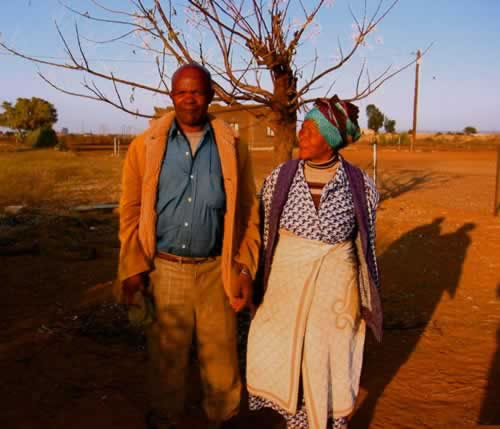 |
Wendy's
parents — Maggie and Ishmael
"name here is Kagiso (ka hee sho)
which means Peace" |
NAMES
Many here have both Setswana and English names. I am
told this comes sometimes from the Christian missionaries and sometimes
from the Afrikaans
employers who wanted “easier” names to work with, and then it
became customary. Also, the Setswana names usually are given for their meaning
— sometimes related to something going on at the birth and sometimes
a hope that the child will grow to take on those characteristics. A few
examples with English interpretation: Mothusi – helper, Ntsako – happiness,
Moabi – last born, Osego – lucky, Lesatsi – sunshine,
Neo – gift.
I was given the name Kagiso – peace. I arrived at this
home on the day the US declared war on Iraq… not sure if that’s
why but I do like the name and folks here are delighted when I introduce
myself as Kagiso Montwedi. Names are not as gender defining
as most of ours — any of the above names might belong to a boy or a girl. Since apartheid
ended
in ’91 and the new democratic constitution was formulated by the government
elected in ‘94, there is an effort by some encouraging blacks to drop
the English name appointment. Many of the children I know under 10 have only
a Setswana name (& maybe a nickname like “Snoopy”). People
can tell you in a flash the year any family member was born, but often don’t
know their age without doing the math — opposite of our general
practice.
COOKING
The photo of the women cooking shows the type of
pot used by most rural families — over a wood fire. Notice how bleak
the surroundings are — I wonder how long the environment can support
this practice. The stick structure in back of the women is a kraal —
shelter in which the
daily meals are prepared. This photo was taken on the day of a special event
at which an animal was slaughtered so the cooking area extended to outside
the
kraal and relatives came to take part in the process. These cooking kraals
are rebuilt with fresh sticks every winter – photos show my mother
(AMAZING what she does at 74!) beginning the process here now. The old
sticks will be used as firewood. Kraals are also built to contain animals
and as a special place for men to congregate during special occasions.
SPECIAL OCCASION
The special occasion when I took some of these photos was
a “returning of the clothes.” When a man dies, his clothes
are washed and put aside until the following winter. They are then delivered
to an uncle (broad interpretation here — cousins are considered brothers
— very difficult to figure family trees the way we define relationships)
in the
village of the mother of the deceased. Family of the deceased arranges for
a goat or cow or sheep to be sent to the receiving family for slaughter the
day before (usually Friday) the delivery. So the family (widely extended
family coming from all corners) slaughters, butchers, cooks, eats that day… clothes
are delivered in the dark of the night so fire has to be kept going for hospitality
(strictest custom has clothes displayed on the branches of the men’s
kraal and deliverers departing before sun-up). Then receiving family obtains
and slaughters another animal that day (usually Saturday). Repeat of prep
process and at some
point “the uncle” calls all the family men together and gives
away each article of clothing. My family has had 3 deliveries since I came
— one this weekend from the tribal chief who died in December. Great amount
of work
and expense. When a woman dies, her clothes are washed and delivered right
away to family members. No hoopala. Another time I’ll tell you
more about funeral related customs.
FOOD
I am very fortunate in my family and housing. Most volunteers here
have electricity but from what I hear, few have as nice a house as mine
with easy transport to groceries etc. and many have just a room in the
family house. Though mom and a couple of kids come here to sleep, I have
it to myself the rest of the time. I have my own kitchen with stove and
fridge so can easily buy/store/cook what I want without too much guilt
that my family in the house next door usually has “pap” (maize porridge)
for every meal. I can’t whine about food as I can find most of
what I want, so I’ll just tell you the things I don’t find: tortillas
(but I’ve learned to make them & they’re not bad!), cake
mixes (but I have a recipe or 3 and have been successful in that too),
cheese (but I can get it in bigger towns about an hour away so can “stock
up” and it keeps), bread choices, crackers/chips (some cheetos type
things come in minibags but no potato chips, soda crackers, wheat thins,
trisket types), brown sugar (here its granulated and doesn’t act
the same), peanut M&M’s, good licorice, jelly beans and Balance
Bars! I know there are other things but nothing drastic. I get decent veggies,
chicken,
fish (frozen), there is beef and other red meat but I haven’t gotten
any. The variety of brands and choices is very limited but that makes shopping
much easier and the real cooks complain about lack of spices. The corn meal
is different — ground finer and not as flavorful as ours. Cabbage
has to suffice for lettuce needs. Good bananas, apples, oranges, tangerines.
Peaches will be here in December so will see what else is good then.
Had great mangos in our training village.
SCHOOL
The photos are all from Lekwene Primary which is doing a lot of positive
things. The “learners” (official designation) line up by class
groups every morning for about 10 minutes of assembly. They do some singing,
an educator leads a prayer, they hear any announcements and mail is distributed
to families who use the school PO box because they can’t afford their
own. Some are barefoot even at this time which is winter, some wear only
sox, many shoes don’t fit so heels are stepped down on or they
may be swimming in them. Shirt collars, hems, cuffs totally frayed. One
wants to help but where to start and where would the end be? Had a very
nice HIV/Aids Awareness assembly put on in large part by nurses from
the clinic down the road. Each child got a candle to light. Had to stand
in assembly order for one hour. Can you imagine US kids doing that? Hmm....
The principal has wanted to have a newsletter so was happy when I offered
to help with it. He and other educators wrote articles (in Setswana)
and I plugged in photos and formatted it on my computer. Turned out to
be 8 pages and all are very proud of it. This school bought a Minolta
laser printer on a deal in which they got a copy machine free with purchase…but have
no computer. They have been told by Dept of Ed they will be getting one soon
but are so accustomed to failed promises that they aren’t counting
on that and are saving money to purchase one. Priorities are very difficult
as they have so few resources and there are good arguments for moving many
things to the top of the list. There is no clerical staff and I see a computer
as a great tool to shortcut a lot of copying, form making, and record keeping
the educators spend time on now. They have one of the old crank mimeograph
machines they run tests off with — quality is very poor partly because typewriter
is poor. Hope to help them move into computer age. I’ve started working
with some 6th graders on English. Kids here are fluent in 3 languages by
the time they finish HS — Setswana, Afrikaans and English. Makes
it easy for me to communicate on a basic level with most folks 6th grade
and beyond! Yes I’m working on the Setswana but sure feel slow!
Well I could go on and on but must get on with life here so will stop.
Re email — there is one computer in Taung (at least that’s all
the volunteers who have been in the vicinity 2 years have been able to find),
and the charge is by the minute. Doesn’t take long to rack up a big
bill… and Peace Corps doesn’t pay in big bills, so I only check
in once a week. I do enjoy hearing what’s going on in the homeland
but appreciate the short version and can’t promise much of a reply.
These letters my sister is posting will mainly have to suffice for news from
me. An interesting difference in services is that one has to pay ahead of
time for phone and electricity — like putting gas in your car, so sometimes
the Inet connection goes dead in the middle of my session and the shopkeeper
has to go a few blocks away to buy more air time! So if you’re
thinking of writing, snail mail seems to work and Lynn or Elsie or my
sister can give you my e-mail address but I prefer it not to be published
to the world.
Thanks for tuning in … until next time, go siame (ho
see ah mee) “go
well” – Wendy
|